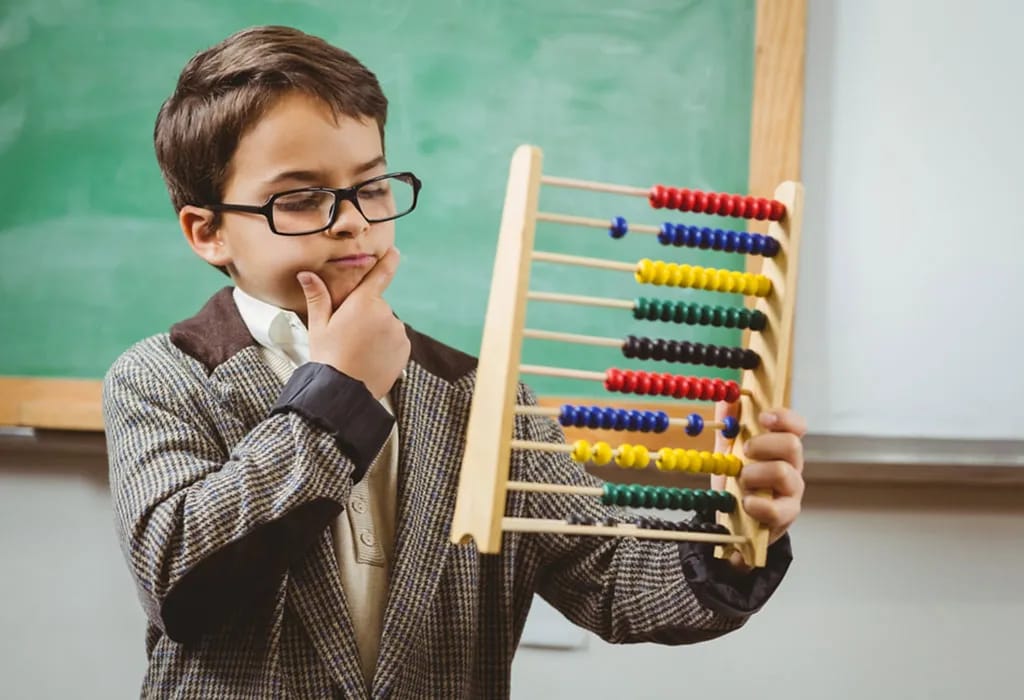

Abacus-based mathematics training is increasingly being promoted by educators and learning centres as an effective way to strengthen children’s numerical ability, concentration, and mental calculation speed. Parents across urban and semi-urban regions are enrolling young learners in abacus classes with the hope of improving overall academic performance, especially in mathematics.
Education experts explain that abacus learning involves visualizing numbers and performing calculations mentally using an imaginary frame of beads. This process is believed to activate multiple areas of the brain, enhancing memory, focus, and problem-solving skills alongside arithmetic accuracy. Teachers report that children trained in abacus methods often demonstrate quicker mental addition, subtraction, multiplication, and division compared to peers relying solely on conventional techniques.
However, some academic researchers caution that while abacus training can improve calculation speed and confidence, long-term improvement in higher-level mathematical reasoning depends on broader conceptual learning. They emphasize that abacus should complement, not replace, standard classroom instruction and logical understanding of mathematical principles.
Parents who have enrolled their children in such programs commonly report positive behavioral changes, including improved attention span, discipline, and reduced fear of numbers. Educational psychologists note that structured practice and early engagement with numbers can play a meaningful role in shaping a child’s learning habits.
As demand for skill-based learning grows, abacus education continues to find a place in after-school programs. Experts conclude that when balanced with conceptual teaching and regular schooling, abacus training can serve as a supportive tool in developing strong foundational math skills among young learners.