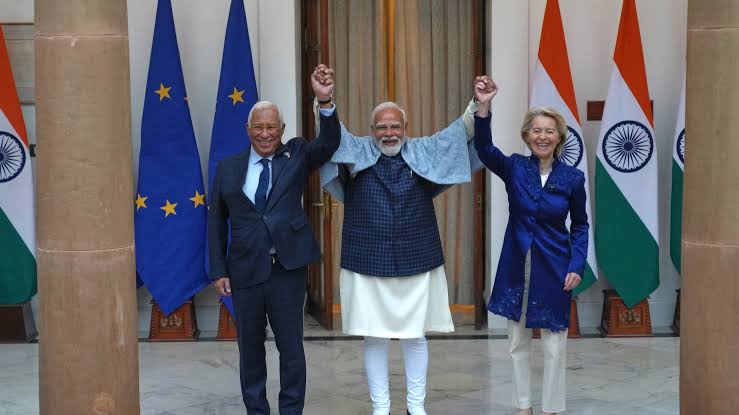

India and the European Union have formally finalised a long-awaited Free Trade Agreement (FTA), marking a major milestone in bilateral economic relations and sending a clear strategic signal amid growing global trade tensions. The agreement is widely seen as a calibrated response to the United States’ continued imposition of heavy tariffs on several Indian goods entering the American market.
The comprehensive trade pact aims to significantly reduce or eliminate duties on a wide range of goods and services, boost investment flows, and strengthen supply-chain cooperation between India and the 27-nation EU bloc. Key sectors expected to benefit include pharmaceuticals, engineering goods, textiles, automobiles, renewable energy, and digital services.
Policy experts note that the timing of the agreement is crucial. Over the past few years, Indian exporters have faced higher tariff barriers in the U.S., particularly in steel, aluminium, agricultural products, and certain manufactured goods. These measures have constrained market access and increased costs for Indian businesses. By deepening trade ties with the EU, India is diversifying its export destinations and reducing over-dependence on any single market.
Government sources described the FTA as “economically pragmatic and geopolitically significant,” underlining India’s intent to engage with like-minded partners who support rules-based, fair trade. For the EU, the agreement offers access to one of the world’s fastest-growing major economies and a stable manufacturing and consumer base.
The pact is also expected to enhance India’s negotiating leverage globally. Analysts believe it strengthens New Delhi’s position in future trade discussions with Washington, conveying that unilateral tariff actions will be met with strategic realignments rather than concessions.
With the India–EU FTA now finalised, businesses on both sides are preparing to tap into expanded market opportunities, while policymakers view the deal as a decisive step in reshaping India’s global trade architecture in an era of rising protectionism.